

What Future for the Fish in our Seas? Consultation Report is available
Consultation Report is available by clicking on the image above.
The Background Paper is available for download by clicking here.
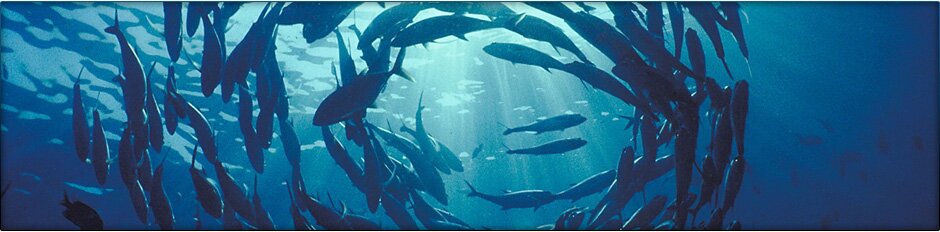
Competition for fish in the sea has grown much more intense in the past 50 years. Not so much because there are more mouths to feed as because of technology: the power of fishermen to catch fish in greater numbers and in deeper water has grown by leaps and bounds. Fish can’t keep up. The stocks of fish that we have drawn on for centuries are now running desperately short.
Attempts to manage fish stocks by limiting fishing effort and catches have acquired more importance, often in ways that fishermen experience as damaging. The British fixation with cod took a hit when the Icelanders shut our trawlers out from the 1960s onwards, to protect their own livelihoods. Our fishermen fell back increasingly on the North Sea. Fish stocks there came under new pressure with the creation of Europe’s Common Fisheries Policy (CFP) in the 1970s. Herring stocks collapsed; cod and haddock became scarcer; and our fishermen gradually moved on to other areas and other species – abusing the CFP roundly as they went.
Our British preference for cod or haddock and chips, even if no longer wrapped in newspaper, dies hard. When our tastes have shifted, it has sometimes had the effect of moving the problem of over-fishing from one species to another. Not much help to the fish if we all demand monkfish one year, sea bass the next. We recreate scarcity in quick time; scarcity sends prices up; fish moves from being good cheap protein for everyone to being good, but pricy, protein for the better-off. To ease the situation, our celebrity chefs are valiantly trying now to persuade us that many other types of fish taste good too, and need no elaborate preparation.
But where is all this leading us? Are we not just moving the problem around? Are we, to take up the message in its starkest form, ‘at the end of the line’? History is certainly trying to get through to us that stocks of fish in the sea are not inexhaustible. Can we find ways of not driving fish to extinction? Can we adopt the approach of the rational optimist, and use human ingenuity to make fishing sustainable? Or does human ingenuity, when it comes to sea fisheries, fall foul of human greed?
The pressures on sea fish stocks around the UK are just part of a much wider picture. Similar problems are faced in many parts of the world. The solutions will vary with types of fishery and systems of management. The Prince of Wales’s International Sustainability Unit has launched a consultation with the aim of building consensus on transition to more sustainable, resilient fisheries. Discussion at St George’s House can, we hope, contribute to this by putting the situation in European waters under closer scrutiny and calling on all interested parties to see how they can work together for mutual benefit.
The Consultation concentrated on the systems of management that come with the Common Fisheries Policy, and on issues currently at the forefront of discussion in Britain in relation to the management of fish stocks and the shaping of consumers’ tastes, homing in on achievable ideas for bringing about a sustainable balance between demand and supply.
St George’s House brought together leading representatives of the fishing industry; of supermarkets; senior officials with responsibility for shaping policies for the industry in the EU and in government in this country; people concerned with consumers’ behaviour and how best to influence it; experts on wider environmental impacts; and people who are concerned with the problem of over-fishing from universities or from independent positions.
This Consultation was led by Richard Carden, one of our House Fellows.


